Integrating WonderTwin
This guide walks the lifecycle of bringing WonderTwin into your application: getting twins running on your laptop, wiring your app to talk to them in dev, moving to hosted staging, running them in CI, and the bright line at production.
Audience: engineers integrating WonderTwin into an existing codebase.
Pre-reqs: you’ve installed the wt CLI and know which external services your application talks to.
The substitution model
Section titled “The substitution model”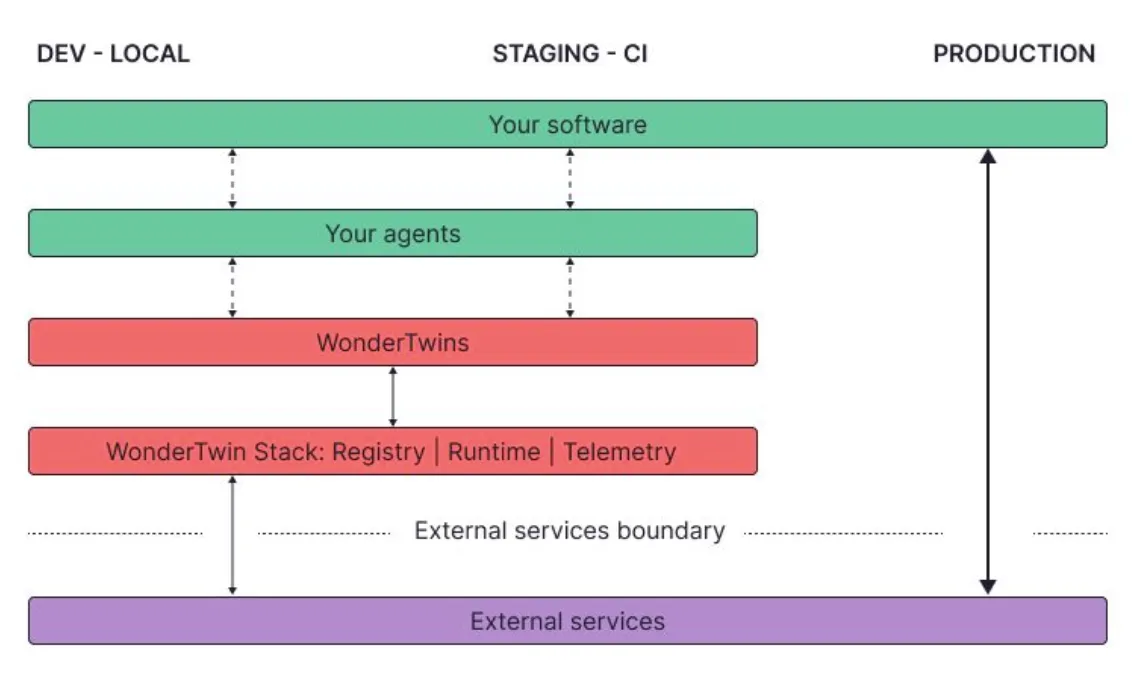
WonderTwin is an environment-specific layer, not a permanent dependency:
- Dev (local) and staging (CI / hosted non-prod) — your agents talk to WonderTwins; the WonderTwin Stack (Registry · Runtime · Telemetry) sits between your code and the external-services boundary.
- Production — that entire layer is removed. Your software and your agents talk to real external services directly, the same way they would in a world without WonderTwin.
The substitution is layer-level, not endpoint-level. You don’t twin some calls and leave others real within the same environment; you either have the twin layer (dev/staging) or you don’t (production).
The bright line: twins are never used in production. WonderTwin’s SLAs, durability, and operational posture are dev-grade by design. Routing production traffic through a twin is unsupported and explicitly not approved. See prod-no-twins.md for the production-safety check that enforces this in your build.
Reading order
Section titled “Reading order”- Running twins locally — get a single twin running on your machine
- Running your app against local twins — wire your application code to talk to the local twin instead of the real vendor in dev
- Running twins in hosted non-prod environments — staging / preview / shared dev hosts
- Running twins in CI — twinning external services on CI runners
- Running against production services (no twins) — the bright line and how to enforce it in your build
Related
Section titled “Related”guides/ci/— general CI strategy patterns (this guide layers on top for the twin-specific bits)